
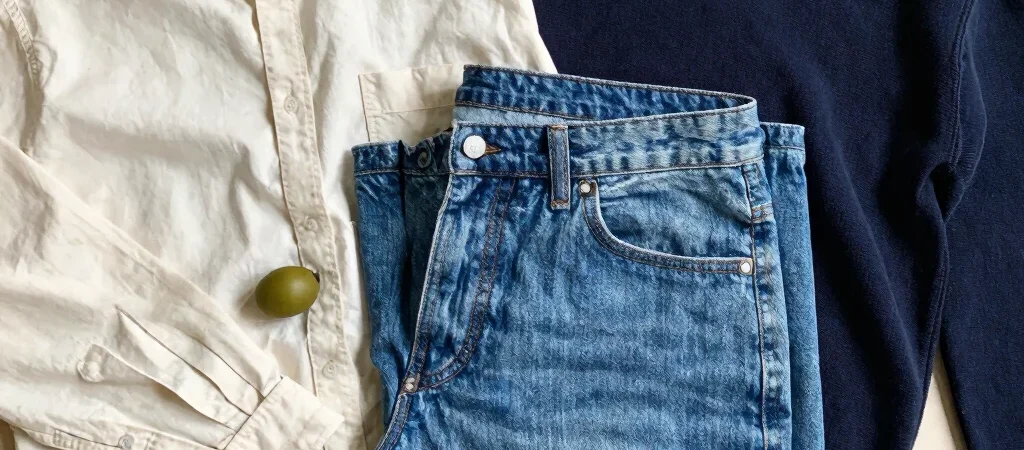
A closet can be full and still leave you staring at the same few combinations. Often, the issue is not a lack of clothes but a lack of connection between them. Choosing three colors to repeat gives everyday outfits a visual thread without asking men or women to dress from a strict uniform.
Pick Colors You Already Wear
Begin with what is already in rotation: perhaps navy, cream, and faded denim, or charcoal, olive, and white. One color can be the anchor, one can soften it, and the third can add a small shift. The best palette is not the most fashionable one; it is the one you can imagine wearing on an ordinary Tuesday.
Lay a few frequently worn pieces together in daylight. Warm beige and cool gray can feel disconnected beside each other, while shades with similar undertones often settle into a more natural combination. You do not need exact matches—variation is what keeps the palette from feeling flat.
Let Fabric Add Contrast
When the colors stay close, texture can carry the outfit. A crisp white shirt with soft denim, a ribbed knit with smooth trousers, or a linen layer over a cotton tee gives the eye a reason to move. That balance works across different aesthetics, from pared-back streetwear to a more polished everyday look.
Think about finish as well as color. Washed black denim feels less severe than a sharply pressed black trouser, and a chunky knit changes the mood of a familiar neutral. These small differences make repeated colors feel like a choice rather than a limitation.
Repeat Without Matching
A palette is a guide, not a requirement that every item coordinate perfectly. Wear the anchor color in larger pieces, then bring in the other two through a shirt, scarf, bag, or shoes. For a quieter outfit, keep the accent small; for more presence, let it take up more space.
Take a quick photo of combinations that feel like you, and notice which colors keep showing up. That is a more useful starting point than building a palette around clothes you rarely choose. Three colors are enough to create coherence—and leave plenty of room for personal style.